Veneers vs Crowns: Which is Better for Front Teeth?
Veneers vs. Crowns: Which Is Better for Front Teeth?
When a front tooth is chipped, discolored, cracked, or worn, the two restorations that come up most often look nearly identical in the end, but they work in completely opposite ways. A veneer is a thin porcelain shell bonded to the front surface of a tooth, relying on a strong enamel bond to stay in place while changing color, shape, and proportion with minimal removal of healthy structure. A crown wraps the entire tooth on every surface and derives its strength from encircling what remains, not from bonding to it. One conserves structure; the other protects what is left of it.
The decision between them is not about aesthetics, since both can produce a beautiful result. It comes down to how much sound tooth structure remains, whether the enamel is intact enough to support a bond, and how that tooth loads when you bite and move your jaw. Getting this wrong in either direction has real consequences: a veneer placed on a tooth that needed a crown is fragile from day one, and a crown placed on a healthy tooth removes structure that did not need to go.
Ready to talk through your specific situation? Call Dr. Preussner's Holliston office at (508) 429-7125 or schedule a consultation.
What This Guide Covers
Front teeth carry a different set of demands than any other tooth in your mouth, and the restorative choices that work well on a molar often fall short up front. At Barbara Preussner DMD in Holliston, Dr. Preussner walks patients through those differences in detail before anything is prepped, so the plan you agree to is the plan you understand. Here is what the rest of this guide walks through.
- Why front teeth are their own restorative problem, separate from molars
- The common things that go wrong up front, including chips, wear, staining, gaps, and fractures
- Porcelain veneers in depth, including who they suit and what they cannot fix
- Crowns in depth, covering root canaled, cracked, heavily filled, and badly worn teeth, plus same day versus lab made options
- A side by side comparison of prep, lifespan, reversibility, upkeep, and failure modes
- The appointment sequence, cost considerations, and how to vet a dentist for front tooth work
Why Your Front Teeth Demand a Different Kind of Thinking
Front teeth are on display every time you talk or laugh, but visibility is not the only challenge. Upper front teeth have thinner enamel than molars, a single root, and function as a shearing edge that guides your jaw side to side. A restoration placed even slightly too thick or at the wrong angle gets hit hundreds of times a day in ways a back tooth never would. Natural enamel also lets light pass through and scatter, giving teeth a lifelike quality that opaque material cannot replicate. Gum symmetry matters too: small differences in tissue height read as crookedness even when the teeth themselves are straight.
A front tooth decision is cosmetic and structural at the same time. For complex smile makeover cases, Dr. Preussner works with lab technician Ryan to build a mock-up so patients can see the proposed result before any tooth is touched.
The Five Ways Front Teeth Fail and Why Each One Points Somewhere Different
Before comparing treatments, it helps to name the problem accurately.
Chips and Edge Fractures
These usually trace back to a single event: a fall, a hockey puck, or biting something harder than expected. Small chips often involve enamel only; larger ones can expose dentin and change your smile line. The key question is how deep the damage goes and whether the remaining tooth structure is still solid.
Wear and Thinning
Clenching, grinding, and acid erosion flatten and shorten front edges over years, leaving teeth looking yellower and slightly translucent at the tips. Wear is rarely a single-tooth problem, so the fix rarely involves a single tooth either.
Discoloration
Surface staining from coffee, tea, or tobacco sits on the outside of enamel and often responds to professional whitening. Intrinsic discoloration, such as tetracycline banding, fluorosis, trauma, or a tooth that grayed after a root canal, is inside the tooth and usually needs coverage instead. Which type you have changes the treatment entirely.
Gaps and Spacing
A gap can be closed by moving teeth with Invisalign or by making teeth wider with restorations. Those are not equivalent choices, and widening teeth to close a large space can throw off smile proportions if done without careful planning.
Cracks, Failing Restorations, and Structural Compromise
A vertical crack, a root-canaled tooth, or a tooth held together mostly by old composite is structurally compromised whether or not it hurts. Old bonding also stains and dulls over time, turning once-invisible margins into visible gray lines. In both cases, the question is whether the underlying tooth is still sound or whether it needs more than a surface fix. That distinction is what drives the veneer-versus-crown decision more than anything else.
Porcelain Veneers: What They Fix, What They Can't, and Who They're For
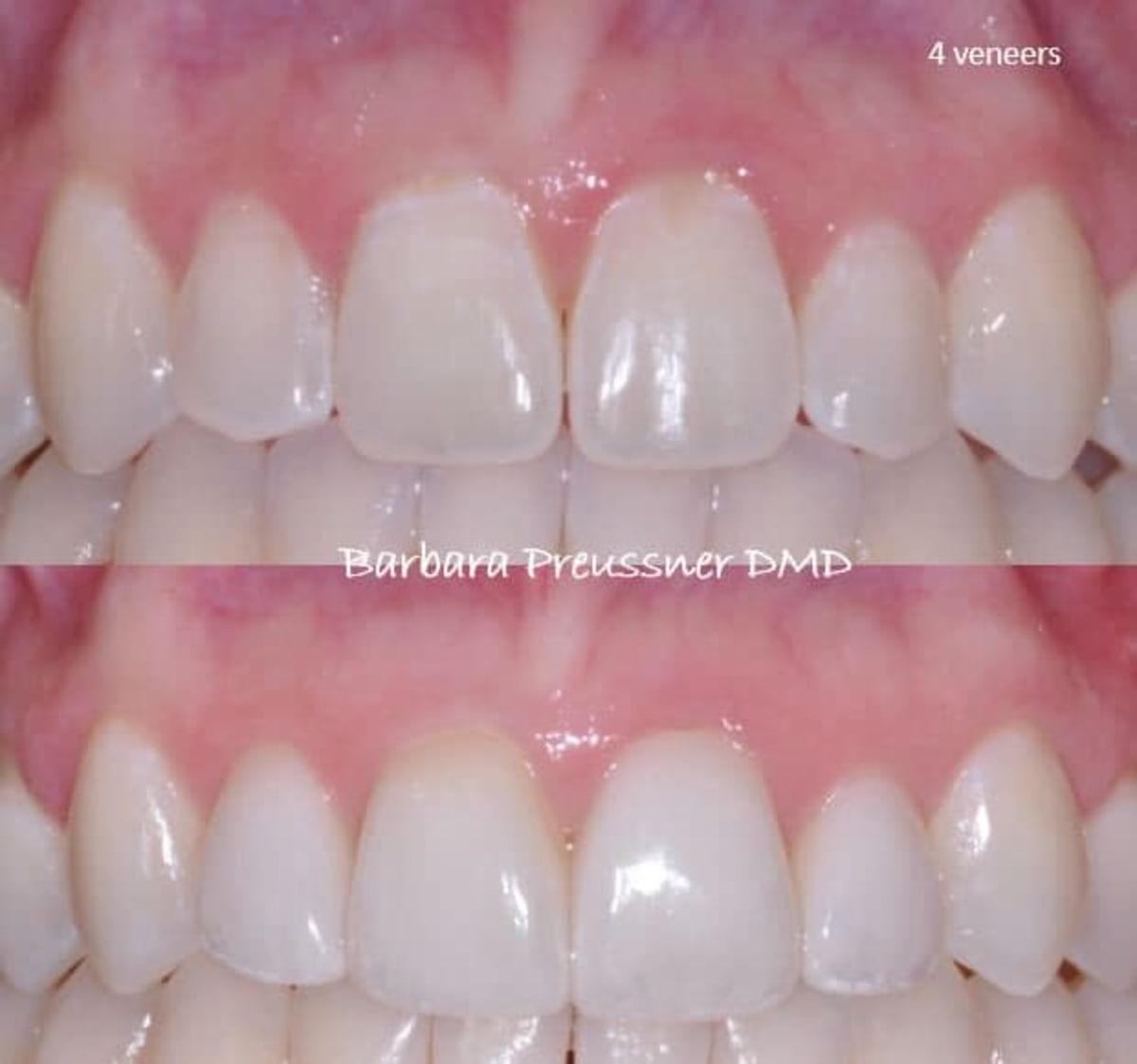
When the tooth is sound and the complaint is appearance, veneers are the most elegant option in cosmetic dentistry. Thin ceramic bonded to the front of the tooth, custom-shaped and shaded, capable of changing a smile without touching structure that's working fine.
Strong Candidates
- Intrinsic discoloration that professional whitening won't budge
- Small chips or worn edges on otherwise healthy teeth
- Teeth that read too short, too narrow, or slightly uneven in shape
- Small gaps between front teeth
- Mild overlap or rotation where the teeth are healthy and you don't want orthodontics
- Aging composite bonding that has stained or lost its shape
Where Veneers Are the Wrong Tool
- Significant crowding or a bite that's genuinely off, because faking alignment means grinding away healthy tooth. Invisalign is usually the better starting point.
- Untreated gum disease, as inflamed or receding tissue won't hold a clean margin in place.
- Active decay, a fracture, or very little enamel remaining, because without a sound, enamel-rich surface to bond to, the whole premise weakens.
- Heavy grinding with no management plan, as a nightguard and bite evaluation need to come first.
Veneers are also not reversible. Even a conservative prep permanently changes the tooth, which is why we settle the plan with a mock-up before any enamel comes off.
Root Canals, Cracks, and Heavy Wear: When a Crown Is the Right Answer
Sometimes the most important thing a restoration can do is keep the tooth in your mouth. Full coverage is what does that.
After a Root Canal
A root-canaled front tooth loses its blood supply and a fair amount of internal structure through the access opening, making it more brittle and fracture-prone. These teeth also frequently darken from the inside, something no external whitening will fix. Full coverage addresses both.
Cracked Teeth
A crack under load behaves like a crack in a windshield: force finds it and extends it. Wrapping the tooth distributes that force rather than concentrating it at the fracture line. A restoration covering only the front surface leaves the crack free to keep moving.
Heavily Filled or Severely Worn Teeth
When most of what you see is composite rather than tooth, a crown gathers up what remains and protects it. Advanced wear presents a similar problem. Front teeth become short, thin, and sensitive, and rebuilding their length changes how upper and lower teeth meet. Full coverage gives the room and strength to do that correctly, with the bite planned deliberately.
Same-Day Versus Lab-Fabricated
At Barbara Preussner DMD in Holliston, we offer same-day crowns milled from a digital scan, with one visit, no impression material, and no temporary. For a highly visible front tooth where shade blending is critical, a lab-fabricated crown can offer more artistry. A skilled technician builds color in layers that a single ceramic block cannot fully replicate. Which option fits depends on the tooth and how demanding the color match is, and that is a decision Dr. Preussner works through with you based on what the tooth actually needs.
Veneers vs. Crowns Side by Side: An Honest Comparison
Porcelain Veneers
- Coverage: Front surface only, sometimes wrapping the biting edge
- Tooth Removal: Minimal, mostly a thin layer of enamel
- What It Relies On: The bond to healthy enamel
- Best Suited To: Structurally sound teeth with cosmetic concerns
- Typical Lifespan: Roughly 10 to 20 years with good care
- Reversibility: Not reversible; prep is permanent
- Aesthetics: Excellent, thin ceramic mimics natural translucency beautifully
- Common Failure Modes: Debonding, chipping at an edge, marginal staining
- Maintenance: Brush, floss, nightguard if you clench, avoid biting hard objects
- Insurance: Almost always treated as cosmetic
Dental Crowns
- Coverage: Entire tooth, all surfaces
- Tooth Removal: Substantial reduction on every side
- What It Relies On: Its own encircling strength
- Best Suited To: Root canaled, cracked, heavily filled, or badly worn teeth
- Typical Lifespan: Roughly 10 to 20 years, with an advantage under heavy load
- Reversibility: Not reversible; more structure removed than with a veneer
- Aesthetics: Excellent, though opacity can be harder to manage on a single front tooth
- Common Failure Modes: Decay at the margin, cement failure, fracture of the tooth root
- Maintenance: Brush, floss, nightguard if you clench, with extra attention to the gum line margin
- Insurance: May be partially covered when structural need is documented
Both restorations can last 10 to 20 years. What separates outcomes is whether the restoration matched the tooth, how precisely it was fitted and bonded, and your habits afterward. Dr. Preussner walks through each of these factors as they apply to your specific teeth, so the plan you agree to fits your bite and your life.
What to Expect: Timeline, Appointments, and Comfort
Timing surprises are one of the most common frustrations with cosmetic dental work. Here is the realistic sequence at Barbara Preussner DMD in Holliston.
1. Consultation and Records
We listen first: what bothers you, what you want, what you have already tried. Then photos, X-rays, a digital scan, and an evaluation of your bite and gum tissue. Nothing is prepared at this visit.
2. Planning and Mock-Up
For multi-tooth front cases, we involve lab technician Ryan to build a mock-up so you can see the proposed result before any tooth is touched. You react to shape and length while everything is still changeable. Mock-up costs vary with the number of teeth involved, and we tell you that number upfront.
3. Any Groundwork First
Gum treatment, whitening, or tooth movement happens before restorative work. This step most often extends the timeline, and it protects the result. Whitening goes first because the shade you finish with is the shade the porcelain gets matched to.
4. Preparation, Temporaries, or Same-Day
For lab-made veneers or crowns, teeth are prepared under local anesthetic and temporaries go on. They let you test the new shape while eating and speaking, which provides useful feedback before the finals. With a same-day crown, the scan, milling, and fit all happen in one appointment with no temporary and no second visit.
5. Final Placement
Fit, margins, shade, and bite are all checked before anything is permanently cemented or bonded. If something is not right, we fix it rather than seat it. Mild gum tenderness or brief cold sensitivity afterward is normal and settles quickly.
What Front Tooth Restoration Costs and How to Plan for It
Veneers and crowns tend to land in a similar range per tooth. Your actual number depends on how many teeth are involved, whether groundwork like gum treatment or alignment is needed, and the materials the case calls for. For multi-tooth cases, budget for the mock-up Dr. Preussner builds with lab technician Ryan. It converts a plan you have to imagine into something you can see and approve before any tooth is touched. All costs are reviewed in writing at your consultation, with payment options discussed then.
Barbara Preussner DMD is an independent, fee-for-service practice, so recommendations follow what your tooth needs, not what an insurance plan reimburses. When a crown qualifies for partial benefits, plans typically require documented structural need: a fracture or significant decay recorded in the chart and on X-ray. The real expense to avoid is choosing the wrong restoration, watching it fail early, and paying again. A correctly chosen restoration placed well is the cheaper path over twenty years, and that starts with getting the decision right from the beginning.
Questions Worth Asking Any Dentist Before They Touch a Front Tooth
The material matters far less than the judgment behind the plan. Before agreeing to any treatment, ask:
- How do you evaluate my bite before designing restorations?
- Will I see a mock-up before any tooth is prepared?
- Can I see before and after photos of front teeth you personally restored?
- Who makes my restorations, and do you work directly with that technician?
- What could go wrong, and what would you do about it?
Dr. Preussner completed extensive postgraduate training with the Dawson Center for Advanced Dental Study and Spear Education, leads a monthly Spear Study Group, and serves as an instructor and faculty member with the American Academy of Facial Esthetics. Both programs treat occlusion and aesthetics as one system, so how your jaw moves, your bite, and your smile proportions are all planned together rather than treated separately.
Where to Go From Here
You can narrow this down a long way on your own. If your teeth are structurally sound and your complaint is color, shape, or a small gap, veneers, bonding, or professional whitening are the likely conversation. If a front tooth has had a root canal, is cracked, is mostly filling, or is significantly worn, expect full coverage to be on the table for good reason. And if the teeth are healthy but crooked, moving them with Invisalign may beat covering them.
What you cannot do from a webpage is see inside your own tooth. That takes an exam, X-rays, and someone evaluating how your bite loads that specific tooth. A front tooth is the one restoration you will look at every morning for the next twenty years, so choose it based on what is actually under the enamel, not on which word sounds less invasive.
Barbara Preussner DMD is at 479 Washington Street in Holliston. Request a consultation or call (508) 429-7125 to talk it through with Dr. Preussner.
